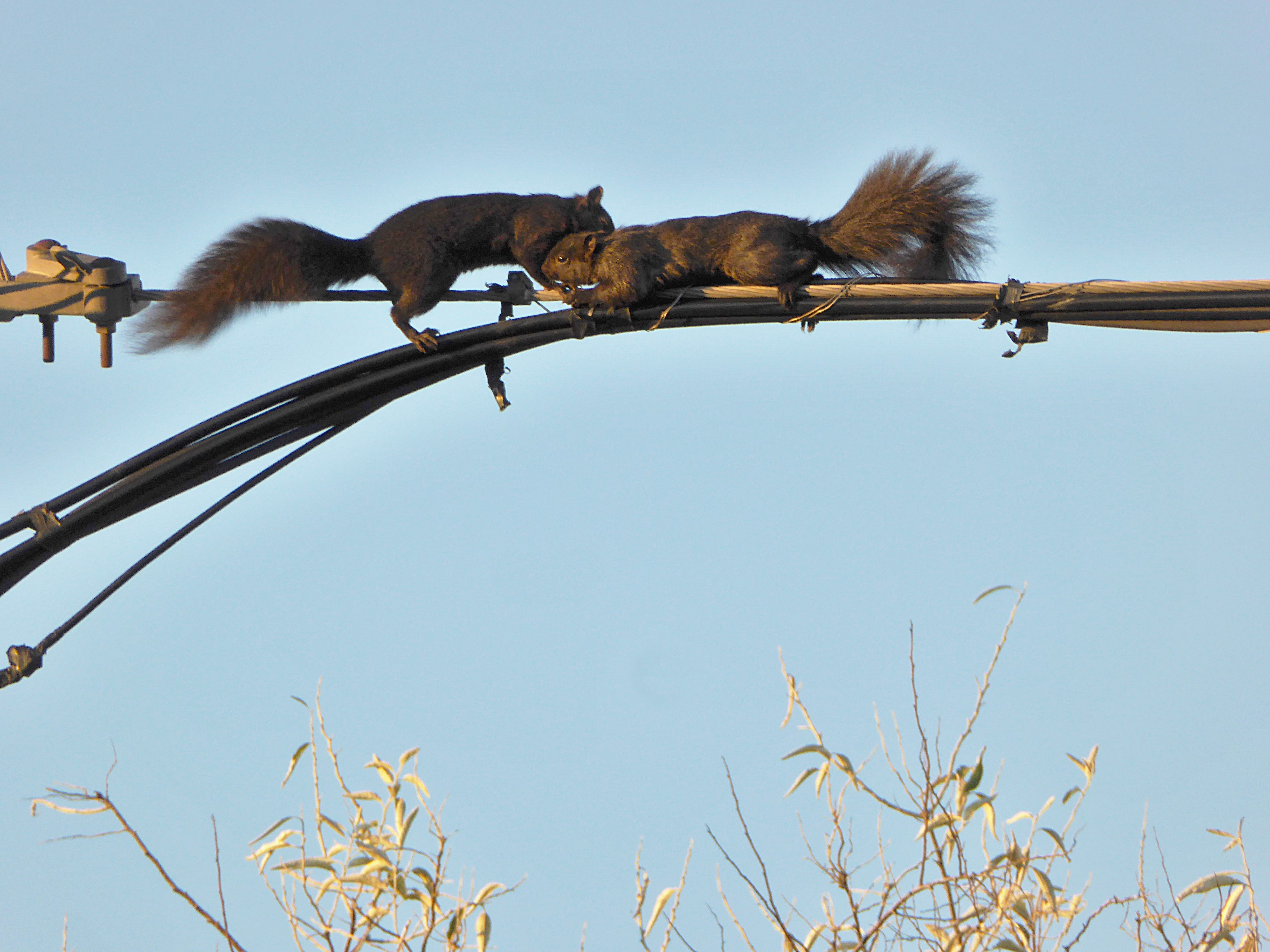
 Two squirrels on a utility cable in Brampton, Ontario. Photo: Pierre André Leclercq (2017). CC BY-SA 4.0.

The Squirrel Threat Model
On December 9, 1987, a squirrel got into a power substation in Trumbull, Connecticut and shorted equipment that fed Nasdaq’s data center. Trading halted for 82 minutes[1], keeping an estimated 20 million shares from changing hands[2].
On August 2, 1994, it happened again. A different squirrel found its way into the same power substation and halted Nasdaq trading a second time. Trading resumed within 34 minutes[3].
Somewhere there is a security budget built around nation-state actors and zero-day exploits. But a squirrel still took down the network underlying the US stock market.
Wildlife outages
Squirrels. John Inglis, a former deputy director of the National Security Agency, said on record that “the No. 1 threat experienced to date by the U.S. electrical grid is squirrels[4].” Before it stopped updating in 2021, Cyber Squirrel 1 logged more than 2,500 animal-caused power incidents, nearly half of them squirrels[5].
Beavers. In April 2021, beavers in Tumbler Ridge, British Columbia, dug three feet down alongside a creek, chewed through a 4.5-inch protective conduit, and then chewed through the fiber cable inside it. About 900 people lost internet service for 36 hours. A Telus spokesperson called it “a bizarre and uniquely Canadian turn of events[6].” It happened again to the same region the following year.
Cows. In May 2020, Google’s SVP of technical infrastructure, Urs Hölzle, live-tweeted an explanation for repeated short outages on a fiber path through Oregon. The fiber ran above ground along power poles, and a farmer had started grazing cattle nearby. Whenever a cow stepped on the fallen line, it bent enough to interrupt traffic[7].
Sharks. Bite marks turned up in an undersea data line off the Canary Islands in 1985. Google now wraps some shoreline cables in protective armor, but marine biologists and telecom engineers are blunt about the actual scale of the threat. “This is probably one of the biggest myths we see cited in the press[8].” Nearly all undersea cable damage comes from something far less exciting: ship anchors and fishing trawlers.
None of the animal-caused outages come close to the damage humans do to their own networks (on purpose or by accident).
One bad command
On October 4, 2021, a Facebook engineer ran a routine command meant to check spare capacity on the company’s backbone network. The command took down every connection in Facebook’s backbone. Audit controls had problems of their own and failed to catch the mistake[9].
Facebook’s DNS servers could no longer speak to their data centers and withdrew their own BGP route advertisements. That withdrawal made the DNS servers unreachable, even though the physical machines were fine. Facebook, Instagram, and WhatsApp disappeared from the internet for about six hours, and engineers even reportedly struggled to get into the affected buildings, since the badge readers ran on that same downed network[9].
Other companies made the same mistake. In January 2017, an engineer at GitLab tried to fix a lagging secondary database, but triggered a destructive command against the primary production database by mistake. Though the command was terminated within two seconds, 300GB of production data had already been removed. Several backup mechanisms failed as well, forcing GitLab to restore from a snapshot from 6 hours prior[10].
A month later, an AWS engineer mistyped a routine maintenance command against Amazon S3, and removed far more servers than intended. A large share of the internet was taken down, including Slack, DockerHub, and GitHub, for about four hours[11]. Amazon’s status dashboard couldn’t update to tell customers what was happening, because it depended on the same system that had just failed[12].
No squirrel has ever done that much damage in a single afternoon.
Criminal mischief
On December 25, 2024, the oil tanker Eagle-S dragged its anchor roughly 100 kilometers across the Baltic seabed, severing the Estlink-2 power cable and four telecom cables between Finland and Estonia. Finnish investigators later matched the seabed drag mark pattern to the ship’s anchor. Eagle-S was flagged in the Cook Islands and found to be part of Russia’s shadow fleet[13].
Estlink-2 stayed offline for nearly six months, and repairs cost an estimated 60 million euros. Finnish prosecutors charged the ship’s officers with aggravated criminal mischief rather than deliberate sabotage[13]. Several other Baltic cables have been severed the same way since 2023.
Salvage value
On March 28, 2011, a 75-year-old woman scavenging for copper near Tbilisi struck a buried fiber-optic cable with her shovel. The cable carried most of Armenia’s internet traffic, taking the country offline for hours, along with parts of Georgia and Azerbaijan[14].
Between June and December 2024, nearly 6,000 incidents of telecom theft (copper wire mostly) disrupted service for an estimated 1.5 million customers. A stolen spool of copper wire might fetch a few hundred dollars at a scrapyard. Lost productivity and disrupted access to emergency services was estimated to cost $38 million to $188 million[15].
Where people get this wrong
A shark bite or a squirrel outage makes a good story. But wildlife-caused outages are not as significant as human error or human theft.
Teams harden against dramatic, low-probability scenarios while a mistyped maintenance command or copper cable pulled out of a rural span is the far likelier way the network goes down.
Put it into practice
The squirrel makes a better story, but building for the boring failure is likely the smartest place to invest.
Compare your threat model to your actual incident history. Sort the past year of incidents/outage tickets by contributing factor(s) instead of by how good the postmortem story was.
A command capable of disconnecting an entire backbone should never run without guardrails, and the safety check(s) need to be tested as carefully as the systems it protects. Peer review, staged rollouts, and continuous verification matter just as much.
References
- UPI (1987). "Power failure interrupts NASDAQ, hurts computer." UPI Archives, December 9, 1987. https://www.upi.com/Archives/1987/12/09/Power-failure-interrupts-NASDAQ-hurts-computer/6430566024400/
- Gilpin, Kenneth N. (1987). "Stray Rodent Halts Nasdaq Computers." The New York Times, December 10, 1987, p. 33. As reproduced in The RISKS Digest, Volume 5, Issue 72.
- Neumann, Peter G., ed. (1994). "Squirrels bring down NASDAQ." The RISKS Digest, Volume 16, Issue 30, August 2, 1994. https://catless.ncl.ac.uk/Risks/16/30
- Smithsonian Magazine (2015). "Move Over Hackers, Squirrels Are the Power Grid's Greatest Foe." https://www.smithsonianmag.com/smart-news/move-over-hackers-squirrels-power-grid-greatest-foe-180957834/
- Cyber Squirrel 1 (2021). https://www.cybersquirrel1.com/
- CBC News (2022). "For the second year in a row, a beaver is to blame for phone and internet outages in northern B.C." https://www.cbc.ca/news/canada/british-columbia/beaver-bc-internet-outage-1.6483965
- Hölzle, Urs (2020). Twitter/X post, May 21, 2020. https://twitter.com/uhoelzle/status/1263333281891708929
- Marquez, Melissa Cristina (2020). "Our Underwater World Is Full Of Cables, That Are Sometimes Attacked By Sharks." Forbes. https://www.forbes.com/sites/melissacristinamarquez/2020/07/20/our-underwater-world-is-full-of-cables-that-are-sometimes-attacked-by-sharks/
- Meta Engineering (2021). "More details about the October 4 outage." https://engineering.fb.com/2021/10/05/networking-traffic/outage-details/
- GitLab (2017). "Postmortem of database outage of January 31." https://about.gitlab.com/blog/postmortem-of-database-outage-of-january-31/
- Gremlin (2025). "After the Retrospective: The 2017 Amazon S3 Outage." Gremlin Blog. https://www.gremlin.com/blog/the-2017-amazon-s-3-outage
- Amazon Web Services (2017). "Summary of the Amazon S3 Service Disruption in the Northern Virginia (US-EAST-1) Region." https://aws.amazon.com/message/41926/
- NPR (2024). "What to know about Finland, Russia's 'shadow fleet' and a severed undersea cable." https://www.npr.org/2024/12/31/nx-s1-5243302/finland-russia-severed-undersea-cable-shadow-fleet
- Parfitt, Tom (2011). "Georgian woman cuts off web access to whole of Armenia." The Guardian, April 6, 2011. https://www.theguardian.com/world/2011/apr/06/georgian-woman-cuts-web-access
- Lopez, Edward J. (2025). "The Real Costs of Communications Outages due to Infrastructure Theft or Vandalism." NCTA. https://www.ncta.com/wp-content/uploads/2025/10/Economic-Impact-Study_1001_2025.pdf
Outtakes
In 2016, a vervet monkey fell onto a transformer at Kenya’s largest hydropower station, overloading nearby machines and cutting power to an estimated 4.7 million households and businesses for more than four hours. The monkey survived (NPR, 2016).
Roughly 100 nesting pairs of great spotted woodpeckers are behind a wave of pole damage across Wicklow and Wexford, hollowing out wooden poles while hunting for nest sites. Ireland’s ESB Networks says the resulting rot is what forces the scheduled outages that follow (Irish Times, 2023).
A raccoon touching live equipment inside a New Jersey substation before dawn in July 2025 set off an explosion that knocked out power across two states, though crews had most customers back within 35 minutes (News 12, 2025).
Changelog
2026-09-12 Fixed the Nasdaq squirrel citations (again), and the Eagle-S/Estlink-2 dates.
2026-08-08 Fixed the Nasdaq squirrel citations.
2026-08-05 Added the copper-scavenging anecdote, corrected the cow citation to Hölzle’s original tweet.
2026-08-02 Initial release.